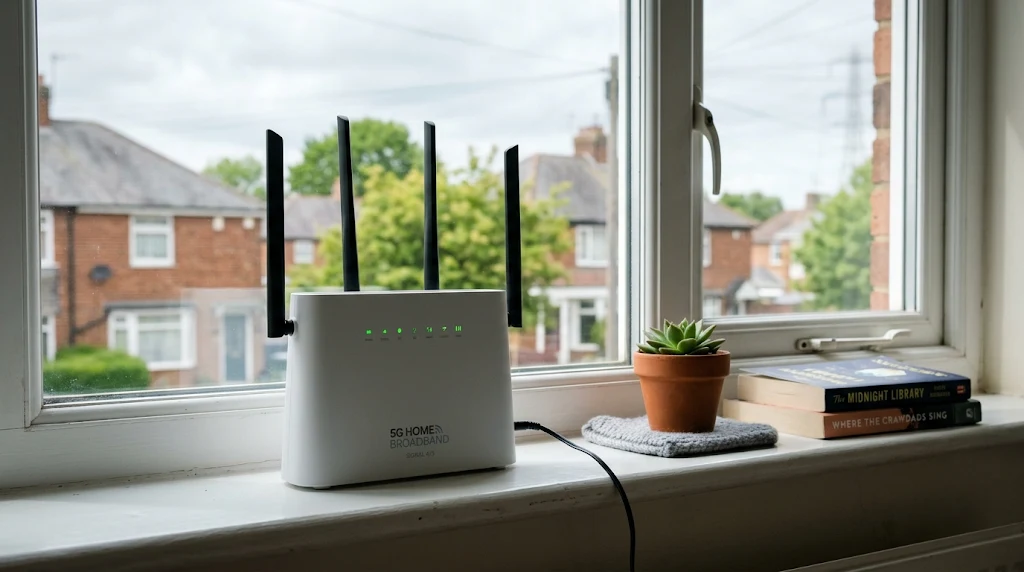
Most of us still think of home broadband as something that comes through a cable in the wall. You book an engineer, wait a couple of weeks, and hope they turn up on the right day. 5G home broadband skips all of that. It uses the same mobile network as your phone, but with a dedicated router built to make the most of the signal.
It’s become a genuine alternative to fixed-line broadband for a lot of households. It isn’t perfect, though, so here’s what it’s really like.
How does 5G home broadband work?
Instead of a phone line or fibre cable, a 5G router picks up a signal from a nearby mobile mast and turns it into WiFi for your home. You plug it into the mains, pop in the SIM card, and that’s more or less it.
In the UK, Three, Vodafone and EE all offer 5G home broadband, along with a handful of smaller brands that use their networks.
The benefits
Setup takes minutes, not weeks
This is the bit people tend to love. There’s no engineer visit, no drilling and no waiting for an installation slot. The router usually arrives within a day or two, and you can be online within minutes of plugging it in.
If you’ve just moved house and the fixed-line installation is three weeks away, that alone can be a lifesaver.
Speeds are often better than you’d expect
Real-world speeds depend heavily on where you live, but they can be very good. Independent testing in early 2026 put average 5G download speeds at around 187Mbps on Three, 131Mbps on Vodafone and 92Mbps on EE.
To put that into perspective, that’s faster than many standard fibre packages, and miles ahead of older copper broadband. It’s plenty for streaming in 4K, video calls and a busy household all online at once.
No line rental
You don’t need a landline. If you never use your home phone anyway, that’s one less thing to pay for.
Flexible contracts
Plenty of 5G broadband plans come on 12-month, 24-month or even rolling one-month terms. A one-month plan costs a bit more each month, but it’s ideal if you’re renting, a student, or don’t know how long you’ll be staying put.
You can take it with you
Because it just needs a plug socket, the router moves house when you do. Some people also use it at a holiday home or caravan. Just check your provider’s terms first, as some plans are tied to a registered address.
It can be cheaper
Prices vary a lot, but 24-month 5G deals from Three and Vodafone often start somewhere in the high teens to mid-twenties per month. EE tends to sit at the pricier end. At the cheaper end, that’s competitive with fibre, especially once you factor in no line rental and no setup fees.
The catches
It wouldn’t be a fair guide without the downsides.
It all depends on your signal
This is the big one. If you’ve got strong 5G coverage, it can be brilliant. If you’re on the edge of coverage, or your house has thick stone walls, speeds can drop sharply. Some routers fall back to 4G when 5G isn’t available, which is slower.
Always use the provider’s coverage checker for your exact postcode before you sign up.If you can, test the 5G signal on your phone in different rooms. That’ll give you a rough idea of where the router should live.
Speeds can go up and down
Mobile networks are shared, so speeds can dip when lots of people nearby are online, typically in the evening. Fibre is usually more consistent from hour to hour.
Latency is a touch higher
Latency (the delay before the connection responds) is generally higher on 5G than on full fibre. For browsing, streaming and video calls you won’t notice. If you’re a competitive online gamer, you might.
Router placement matters
A 5G router works best near a window, ideally on the side of the house facing the mast. Tucking it behind the TV in a back room can cost you a lot of speed. It’s worth moving it around for a day or two to find the sweet spot.
5G vs fibre: a quick comparison
| 5G home broadband | Full fibre | |
|---|---|---|
| Setup | Plug in and go | Engineer visit, sometimes weeks of waiting |
| Typical speed | Around 90 to 190Mbps, depending on network and signal | 150Mbps to 1Gbps+ |
| Consistency | Can vary through the day | Very consistent |
| Contracts | 1, 12 or 24 months | Usually 18 or 24 months |
| Moves with you | Yes | No |
| Needs a landline | No | No |
Is 5G broadband right for you?
It’s well worth a look if:
- you’ve got strong 5G coverage at home
- you’re renting or likely to move in the next year or two
- you need to get online quickly, without waiting for an installation
- your current broadband is slow and full fibre isn’t available yet
- you don’t want to pay for a landline you never use
You might be better off with fibre if:
- full fibre is available and you want the fastest, most consistent speeds
- you’re a serious online gamer
- your 5G signal indoors is patchy
- lots of people in your house are online at the same time, all day
Our verdict
5G home broadband has come a long way. For many homes, especially in towns and cities with good coverage, it’s fast, affordable and refreshingly hassle-free. It’s not going to beat full fibre for out-and-out speed or reliability, but it doesn’t need to. For a lot of people it’s simply good enough, and far easier to get.
The key is checking your signal before you commit. If the coverage is there, it could be one of the easiest switches you ever make.
Want to see what’s available where you live? You can compare broadband deals at your address, check out Three home broadband and Vodafone broadband, or run a speed test to see how your current connection compares.